 Choisir votre langue / Choose your language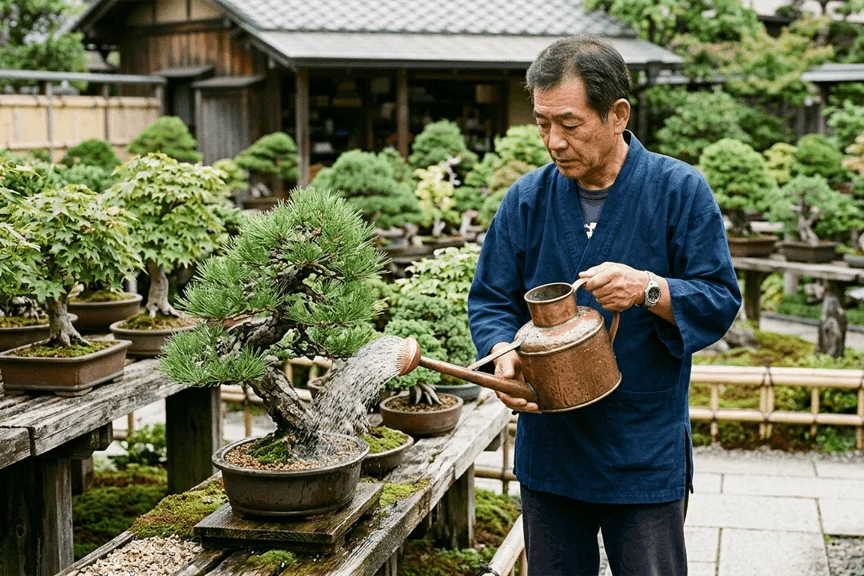
Image generated by AI
Watering Bonsai: Secrets from Japanese Masters so You Never Fail Again
Claude Savard
CSCeramique
Watering is one of the most important skills in bonsai cultivation. Yet, many enthusiasts lose their trees to a lack of water or, conversely, overwatering. This step seems simple. However, it requires observation, rigor, and a good understanding of each species' needs.
Furthermore, a myth persists to this day: a bonsai should be watered once or twice a week. In reality, this statement is false. Many beginners ask, "Which day of the week should I water my bonsai?" Instead, the right question is, "Does my bonsai actually need water today?"
By the end of this article, you will know how to recognize the signs that indicate watering is necessary, understand your trees' needs, and apply effective techniques used by professionals.
The Golden Rule: When Should You Water?
Above all, get to know the species you are growing. Water needs vary considerably depending on whether they are conifers or deciduous trees.
Some species enjoy a constantly moist substrate. Others prefer a well-drained substrate that dries out slightly between waterings. For this reason, observation remains your best tool.
Regularly examine the surface of the substrate. Dry soil generally appears lighter in color than moist soil. With experience, this difference becomes easy to spot.
Additionally, some deciduous trees react quickly to a lack of water. Their foliage wilts or loses its vigor. In this case, watering becomes urgent to prevent significant stress to the tree.

Factors Influencing
Watering Frequency
The Seasons
Water needs change throughout the year. Consequently, you must adjust your watering frequency according to the seasons.
In spring, active growth resumes and water consumption increases. In summer, heat and evaporation speed up the drying of the substrate. In autumn, certain species—especially several conifers—benefit from sufficient water intake to better face the winter. Even during the cold season, some trees require careful monitoring when the substrate is not frozen.
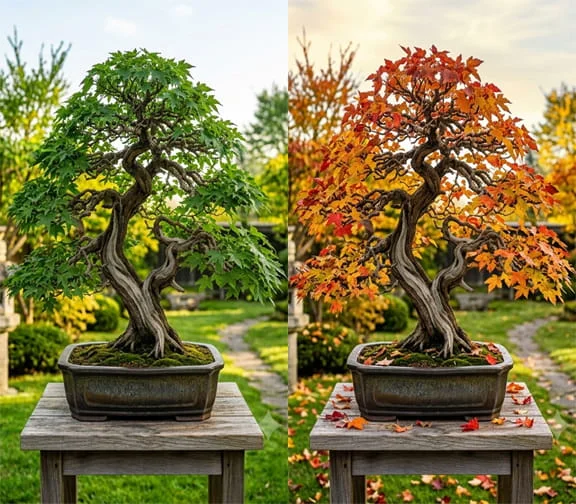
Image generated by AI
Photo montage by CSCeramique
Location
Location directly influences how quickly the substrate dries out.
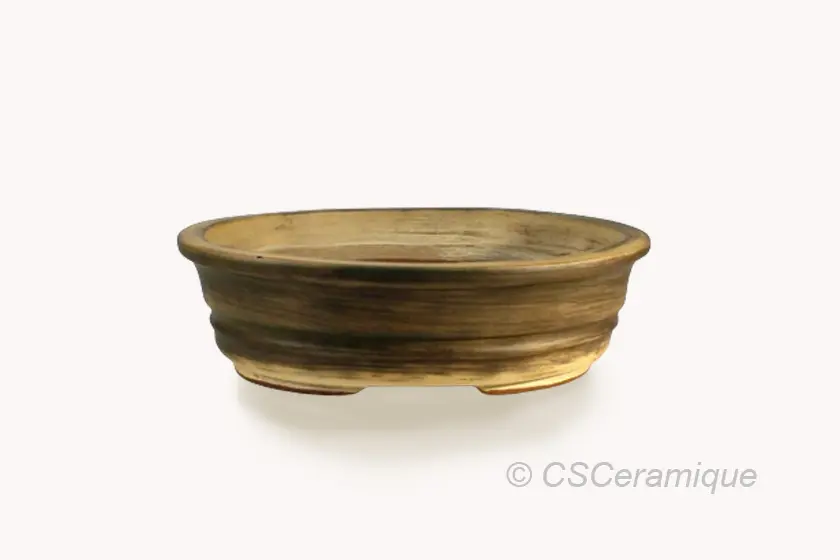
A bonsai placed in full sun all day loses more moisture than a tree grown in partial shade. Furthermore, a dark pot absorbs more heat and accelerates evaporation.
Thus, certain conifers exposed to intense sun during the summer may require watering two or three times a day.
Conversely, a tree placed in a shadier collection will retain its moisture longer.
Pot Size
Pot size also plays a major role.
A small pot holds less substrate. It therefore dries out much faster than a large container.
When this small pot is outdoors, exposed to sun and wind, drying becomes even faster.
For this reason, pay special attention to bonsai grown in shallow pots.
The Importance of Observation
All these factors bring us back to the same conclusion: active observation remains essential.
No universal rule can replace daily inspection of the substrate, leaves, and weather conditions.
The Error to Avoid:
Automatic and Routine Watering
For example, a system programmed to run at a fixed time every day does not always account for rainfall. If it rains heavily and the system turns on anyway, the risk of overwatering increases significantly.
Moreover, a collection often brings together different species, different tree sizes, and different pot volumes. Not all of these bonsai consume water at the same rate.
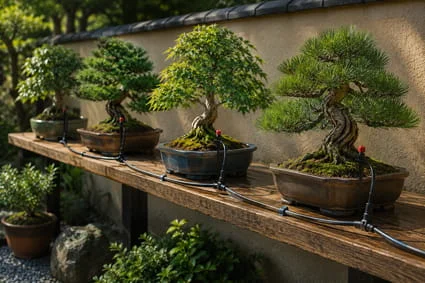
Image generated by AI
Choice of Equipment and Water
Why Use a Fine-Rose Watering Can?
The choice of watering can directly influences the quality of watering.
Professionals often use watering cans fitted with a fine copper rose. Thanks to their numerous small openings, these tools produce a gentle, even rain.
This delicate delivery allows for effective watering without disturbing the substrate. Conversely, a powerful stream can gouge the surface, displace soil particles, and expose surface roots to air and sun.
In the long run, this exposure harms the balanced development of the bonsai.
Which Water to Use?
Water also plays an important role in tree health.
Some enthusiasts analyze the pH and hardness of their water to optimize growing conditions. This approach can be interesting, but it requires a lot of time and adjustments, especially when a collection contains multiple species.
Rainwater
Rainwater is often the best option.
Natural, free, and generally well-suited to the needs of trees, it represents an excellent solution whenever harvesting it is possible.
Image generated by AI
Tap Water
When collecting rainwater is not feasible, tap water remains a completely acceptable option.
However, some municipalities add chlorine or other treatments to drinking water. To limit their presence, let the water sit for about 24 hours before use.
This waiting period has another benefit: the water gradually reaches room temperature. As a result, the roots experience less thermal stress during watering.
Technique:
How to Water Correctly?
The Classic Two-Step Method
When the substrate becomes very dry, water penetrates with difficulty.
In this situation, it can simply slide off the surface or down the sides of the pot before running out of the drainage holes. Many enthusiasts then think they have watered their tree well, when the core of the root ball remains dry.
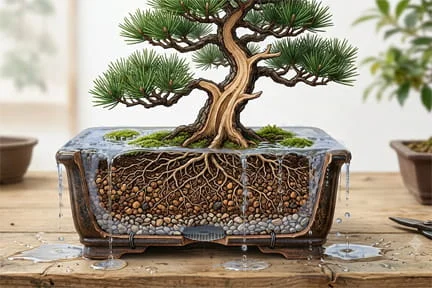
Image generated by AI
Photo montage by CSCeramique
A few minutes later, perform a second, generous watering. This time, the substrate absorbs the water much better. Water until it flows freely from the drainage holes.
If you maintain a large collection, perform a first pass on all the trees. Then, return to the first bonsai to carry out the second pass. This method significantly improves watering efficiency.
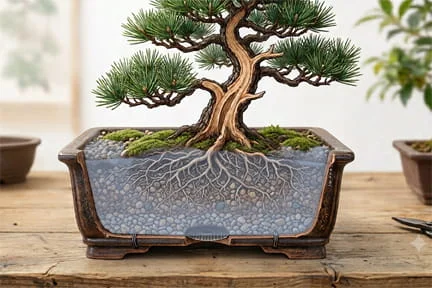
Image generated by AI
Photo montage by CSCeramique
Soaking by Immersion (Submersion)
Place the pot in water for several minutes. Wait until air bubbles stop rising to the surface. Afterwards, let the pot drain properly.
This technique helps rehydrate a very compact or severely dried-out substrate. However, if this situation occurs frequently, it generally indicates that repotting is necessary.
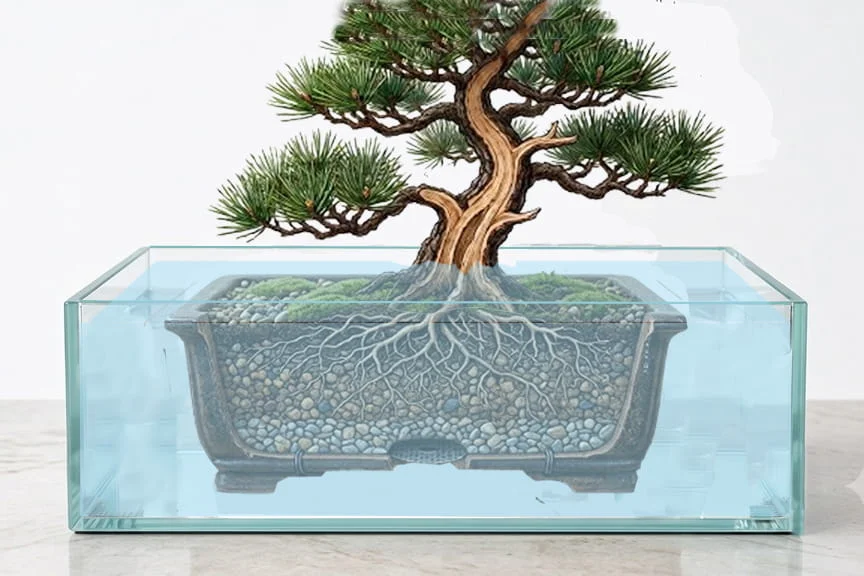
Image generated by AI
Photo montage by CSCeramique
Pitfalls to Avoid
The Saucer Trap
Never leave standing water in a saucer placed under a bonsai pot.
In the long run, this excessive moisture promotes root rot and weakens the tree.
The False Friend of the Spray Bottle
Misting the foliage increases ambient humidity and can be beneficial in certain situations.
However, it never replaces a proper watering of the roots. Its main role is to lightly moisten the surface of the substrate or to refresh the foliage.
Secrets of the Japanese Masters:
The Art of Mizuyari
The Triple Watering Technique
Japanese professionals generally do not limit themselves to a single watering pass.
They often apply the method in three successive steps. The first two steps correspond to the technique described earlier. Then, a third pass ensures complete hydration of the root ball.
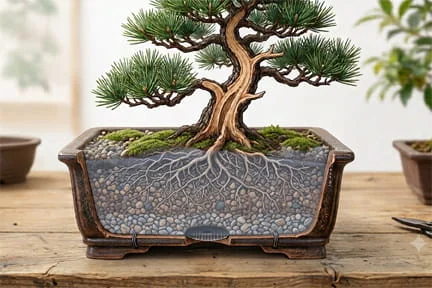
Image generated by AI
Photo montage by CSCeramique
The Copper Rose Watering Lance (Jouro)
Japanese professionals frequently use traditional watering cans or lances fitted with a copper rose featuring hundreds of micro-holes.
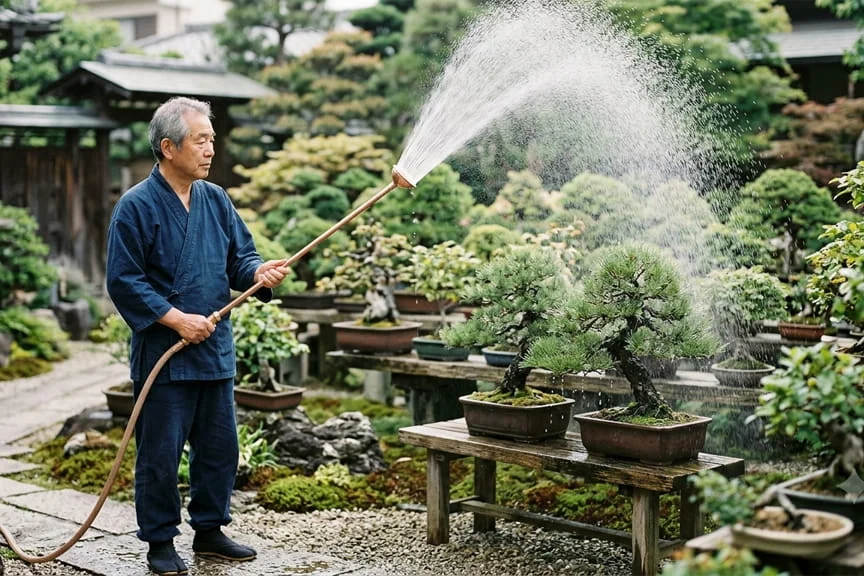
Image generated by AI
This approach mimics the effects of natural rain. It preserves the structure of the substrate, protects surface roots, and washes away accumulated dust on the foliage. Consequently, photosynthesis works more efficiently.
In Japan, this mastery even has a name: "Mizuyari San Nen"—three years to learn how to water correctly. This tradition perfectly illustrates the importance placed on watering in the art of bonsai.
In conclusion
Watering relies neither on a fixed calendar nor an immutable routine. It relies above all on observation. Every species, every pot, every season, and every location changes the tree's water needs.
By carefully monitoring the substrate, adjusting your watering frequency to actual conditions, and applying the techniques used by Japanese professionals, you will significantly increase your collection's chances of success.
Finally, remember one essential thing: a bonsai rarely forgives excesses. Observe, analyze, and step in at the right time. That is how watering becomes not just a technique, but a true dialogue between the enthusiast and their tree.